

When a small business searches for IT support in Surrey, the need is usually practical.
Staff need help when systems slow down, cloud tools need cleaner administration, devices need oversight, and security needs to be part of everyday support.
Reliable managed IT support should make the business feel steadier. It should reduce friction, improve communication, and give leadership a clearer view of what is being managed. For companies in Surrey, Vancouver, Langley, Burnaby, Coquitlam, Abbotsford, Chilliwack, Mission, the Fraser Valley, and nearby BC service areas, the right support relationship can become a major operational advantage.
A good IT partner should not simply wait for tickets. They should understand the business environment, document the important systems, communicate clearly, and help prevent avoidable issues from returning again and again.
▸ Local IT Support Should Feel Accountable
Local BC IT support is not only about geography. It is about accountability, context, and responsiveness.
A small business needs a provider that understands how daily operations depend on technology. If email stops working, staff cannot communicate. If Wi-Fi is unreliable, productivity drops. If a device problem repeats every week, the team loses confidence. If Microsoft 365 access is messy, collaboration becomes harder than it needs to be.
Accountable IT support means the provider owns the issue through resolution. They communicate what is happening, what has been tried, what comes next, and whether a bigger improvement is needed. That matters because business owners do not want vague updates or technical noise. They want clarity.
For a Surrey business comparing managed IT support providers, responsiveness should mean proper triage, clear documentation, escalation when needed, and follow-through until work can move forward.
Fast support is useful. Accountable support is better.
▸ Small Business IT Support Needs More Than Break Fix
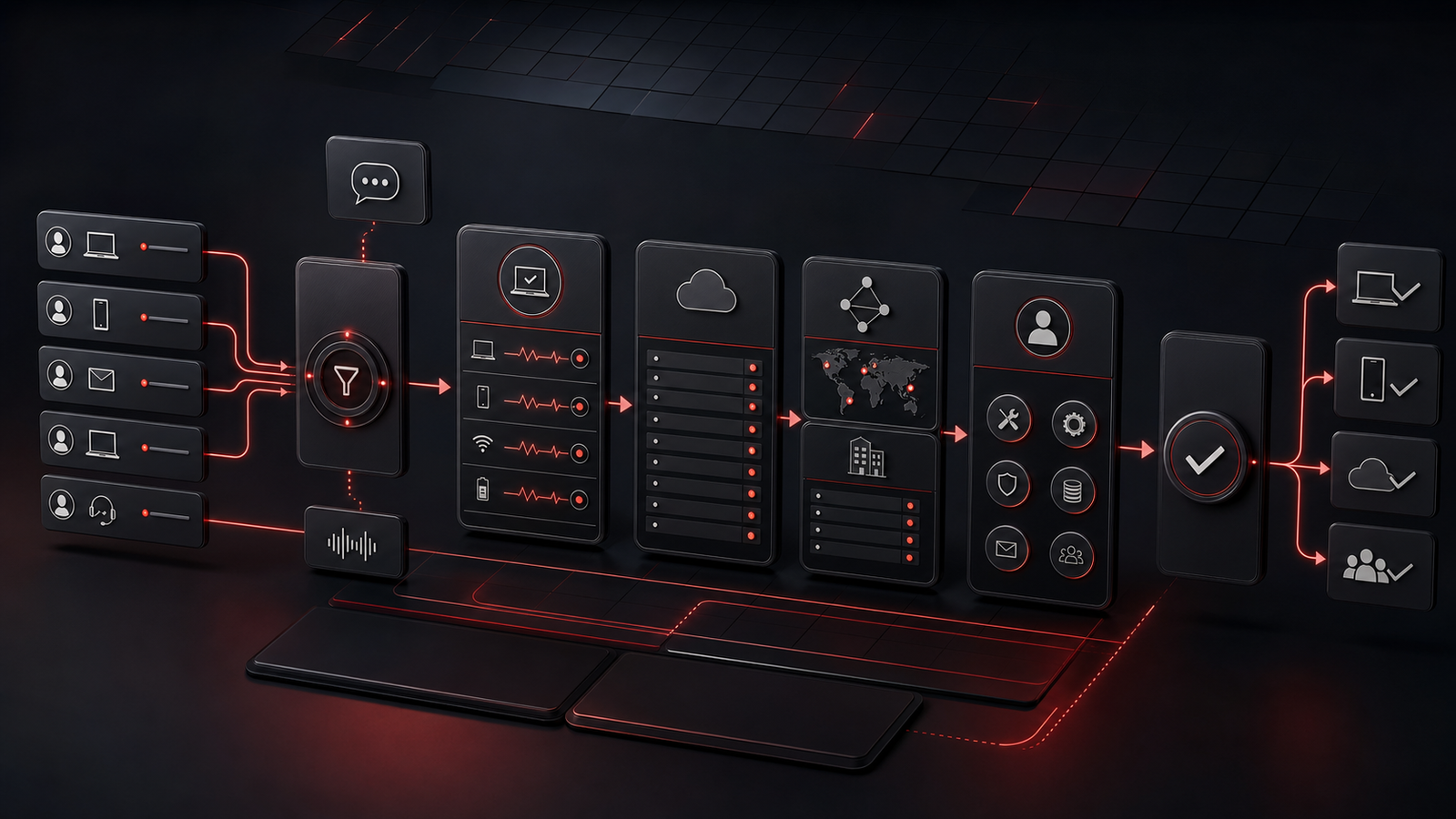
Break-fix support can help when something is already broken, but growing businesses usually need more than emergency troubleshooting.
Small business IT support should cover the everyday operating layer: users, devices, printers, business applications, Microsoft 365, network access, endpoint health, vendor coordination, and staff questions. When these pieces are handled together, support becomes more consistent and the business spends less time chasing separate answers.
A provider should also understand the difference between a one-time issue and a pattern. If the same user problem keeps returning, the answer may not be another quick fix. It may be a training gap, a device health problem, a permissions issue, a poor workflow, or an application configuration that needs review.
This is where managed IT services can create value. The provider sees the environment over time, not just during a single incident. That ongoing view helps identify recurring problems and reduce the background friction that owners often accept as normal.
For small businesses, the best support model is usually the one that keeps staff productive without requiring leadership to personally manage every technical detail.
▸ Managed IT Services Should Include Security Hygiene

Cybersecurity should be built into managed IT services, not bolted on as a separate conversation that happens once a year.
That does not mean every small business needs a complicated security program. It means everyday support decisions should reduce avoidable risk. Devices should be patched. Endpoint protection should be reviewed. Multifactor authentication should be encouraged where appropriate. Former users should be removed. Admin accounts should be limited. Backups should not be assumed to be healthy without some level of review.
Email security, Microsoft 365 settings, remote access tools, user permissions, and vendor accounts all affect the security posture of the business. A managed IT support provider should be able to explain these areas in plain language and help the business prioritize improvements without fearmongering.
This is especially important for companies that do not have internal IT leadership. Owners need practical guidance, not alarmist messaging or technical overwhelm.
Red Shield IT positions cybersecurity as part of dependable operations. The goal is to help businesses make safer choices while still keeping technology usable for staff.
▸ Microsoft 365 and Cloud Support Belong in the Same Conversation
Many small businesses now run a large part of daily work through Microsoft 365 and cloud applications.
That makes cloud administration part of IT support. User creation, licensing, mailbox access, file permissions, SharePoint structure, Teams setup, device access, mobile access, and password recovery all influence how smoothly the business operates.
If Microsoft 365 is managed casually, small problems build up. Licenses may be inconsistent. Former users may remain active. Files may be shared too broadly. Staff may not know where information should live. Owners may not have a clear view of who has administrative access.
A provider offering IT support in Surrey or the wider Lower Mainland should be comfortable helping with Microsoft 365 support as part of the broader service relationship. That does not require official logos or complicated language. It requires clean administration, clear standards, and a practical understanding of how cloud tools support daily operations.
Cloud support should make collaboration easier and more controlled at the same time.
▸ Response Standards Matter More Than Promises
Every provider can promise responsive support. The more useful question is how response is actually handled.
A small business should understand how requests are submitted, how urgent issues are prioritized, what happens after hours, how communication is provided, when escalation occurs, and how recurring issues are reviewed. These standards help set realistic expectations before pressure arrives.
The best support relationships usually have a clear rhythm. Tickets are tracked. Important changes are documented. Repeated issues are discussed. Recommendations are tied to business impact. Leadership is not left guessing whether a problem is being handled.
This matters for managed IT support because the relationship is ongoing. A business is not only buying technical labour. It is buying a service model that should create predictability.
If communication is unclear during normal weeks, it will probably be worse during urgent weeks. Strong response standards help prevent that.
▸ A Good Provider Helps You Plan Ahead

Reliable managed IT services should help a business look beyond the next ticket.
Planning does not need to be complicated. It can include hardware replacement timing, licensing cleanup, Microsoft 365 improvements, backup readiness, security priorities, network upgrades, vendor coordination, and budgeting conversations. These topics help owners avoid surprise expenses and make better technology decisions before something becomes urgent.
For a small business in Surrey, that planning can be especially helpful during growth. New staff, new locations, remote work, cloud adoption, compliance expectations, and changing customer demands all create technology decisions. Without guidance, those decisions can become reactive.
A good provider helps leadership understand what matters now, what can wait, and what should be prepared for. That is where local BC IT support becomes practical advisory, not just a help desk.
Red Shield IT supports businesses with managed IT, cybersecurity, Microsoft 365, continuity planning, infrastructure support, and strategic guidance. The common thread is clarity: helping owners understand what needs attention and why it matters.
▸ Final Thoughts
Choosing IT support in Surrey should not be only about finding someone who can fix a computer when it breaks.
A stronger support relationship should help the business operate with fewer recurring issues, cleaner communication, safer access, better cloud administration, and more confidence in everyday technology decisions.
Look for managed IT support that includes user support, device care, Microsoft 365 administration, network awareness, cybersecurity hygiene, documentation, vendor coordination, and planning. Ask how tickets are handled. Ask how recurring issues are reviewed. Ask how the provider communicates with leadership. Ask whether recommendations are tied to business impact.
Small businesses do not need unnecessary complexity. They need dependable support that keeps work moving and makes technology feel less uncertain.
For businesses in Surrey and nearby BC communities, that kind of support can create a quieter, steadier, more professional operating environment.